


Stevedoring, Transportation, Storage, Bagging, Stuffing in respect of Goods temporarily Imported before Export amounts to Export of Service w.e.f. 01 February, 2019

The members of Gujarat Authority for Advance Ruling, Goods and Services Tax ruled that services such as stevedoring, transportation, storage, bagging, stuffing and again transportation of the goods (which have been temporarily imported into India) rendered by the applicant shall be considered as ‘export of service’ and shall be eligible for ‘Zero Rated Supply‘ w.e.f. 01.02.2019.

The details of the Advance Ruling are as under:

Brief Facts

  • The applicant, a service provider operating in a port, is engaged in handling bulk imported fertiliser on behalf of Indian fertiliser companies. They discharge bulk fertiliser from the vessels, pack it into bags and then make dispatches by Rail, Road and Water.
  • They, as the service providers, did stevedoring, transportation, storage, bagging, stuffing and again transportation of the goods which were temporarily imported.
  • A foreign supplier sent bulk fertiliser for job work in custom bonded godowns.
  • The cargo directly went from vessel to custom bonded warehouses and these goods never crossed the customs barrier and mixed-up with the indigenous goods.
  • These goods were temporarily imported to India for export purpose and stored in customs bonded warehouses and exported from there to outside India.

Questions seeking Advance Ruling

  1. Whether above described services (in brief facts) considered to be Export of Service or not?
  1. If Yes, then we are eligible for Zero Rated Supply under Section 16 of the IGST Act, 2017?

Discussions and Findings

“2(6) “export of services” means the supply of any service when,–

(i) the supplier of service is located in India;

(ii) the recipient of service is located outside India;

(iii) the place of supply of service is outside India;

(iv) the payment for such service has been received by the supplier of service in convertible foreign exchange; and

(v) the supplier of service and the recipient of service are not merely establishments of a distinct person in accordance with Explanation 1 in section 8;”

  • The conditions (i), (ii), (iv) and (v) were satisfied but condition (iv) required further discussion.
  • Section 13(3) of the IGST Act, 2017 provides that the place of supply for services such as the services under discussion shall be the location where the services are performed. However, the second proviso to the mentioned section provides conditions for services to be excluded from Section 13(3).
  • The second proviso, prior to 01 February 2019, excluded the services supplied in respect of goods which are temporarily imported into India for repairs and were exported after repairs without being put to any other use in India, than that which was required for such repairs.
  • The services in discussion could not be considered as repairs and hence, could not be excluded from Section 13(3).
  • However, Notification No.01/2019-Integrated Tax dated 29 January 2019 provided amendment in the second proviso to Section 13(3) to include ‘treatment‘ and ‘process‘ along with ‘repairs‘.
  • The services provided by the applicant were in the nature of job-work and though, the services did not fall under the category of ‘treatment‘, it was considered as ‘process‘.
  • Hence, w. e. f. 01 February 2019, the services in discussion were excluded from Section 13(3) and fell under the ambit of Section 13(2), which stated that the place of supply of such services shall be the location of the recipient of services i.e. outside India.
  • Hence, the services shall be treated as ‘Export of Services‘ w. e. f. 01 February 2019.
  • As per Section 16(1) of the IGST Act, 2017, export of goods or services or both is ‘Zero rated Supply‘.
  • Hence, the services shall be treated as ‘Zero rated Supply‘ w. e. f. 01 February 2019.

Ruling

  1. Whether above described services (in brief facts) considered to be Export of Service or not?
    The services such as stevedoring, transportation, storage, bagging, stuffing and again transportation of the goods (which have been temporarily imported into India) rendered by the applicant shall not be considered as ‘export of service’ up-to 31 January 2019, but shall be considered as ‘export of service’ w. e. f. 01 February 2019, for the reasons discussed herein-above.
  2. If Yes, then we are eligible for Zero Rated Supply under Section 16 of the IGST Act, 2017?”
    The applicant will not be eligible for ‘Zero rated supply’ under Section 16 of the IGST Act, 2017, up-to 31 January 2019 for the reasons discussed herein-above. However, they shall be eligible for ‘Zero rated supply’ as per the provisions of Section 16(1)(a) of the IGST Act, 2017 w.e.f. 01 February 2019, for the reasons discussed herein-above.

Feel free to contact us in case of any clarification required. You can download the entire ruling from here.

Relevant Provisions / References:

Section 2(6) of the IGST Act, 2017

“export of services” means the supply of any service when,—
(i) the supplier of service is located in India;
(ii) the recipient of service is located outside India;
(iii) the place of supply of service is outside India;
(iv) the payment for such service has been received by the supplier of service in convertible foreign exchange 4[or in Indian rupees wherever permitted by the Reserve Bank of India]; and
(v) the supplier of service and the recipient of service are not merely establishments of a distinct person in accordance with Explanation 1 in section 8;

Section 2(14) of the IGST Act, 2017

“location of the recipient of services” means,—
(a) where a supply is received at a place of business for which the registration has been obtained, the location of such place of business;
(b) where a supply is received at a place other than the place of business for which registration has been obtained (a fixed establishment elsewhere), the location of such fixed establishment;
(c) where a supply is received at more than one establishment, whether the place of business or fixed establishment, the location of the establishment most directly concerned with the receipt of the supply; and
(d) in absence of such places, the location of the usual place of residence of the recipient;

Explanation 1 to Section 8 of the IGST Act, 2017

For the purposes of this Act, where a person has,—

(i) an establishment in India and any other establishment outside India;
(ii) an establishment in a State or Union territory and any other establishment outside that State or Union territory; or
(iii) an establishment in a State or Union territory and any other establishment registered within that State or Union territory,

then such establishments shall be treated as establishments of distinct persons.

Section 13 of IGST Act, 2017

(1) The provisions of this section shall apply to determine the place of supply of services where the location of the supplier of services or the location of the recipient of services is outside India.

(2) The place of supply of services except the services specified in sub-sections (3) to (13) shall be the location of the recipient of services:

Provided that where the location of the recipient of services is not available in the ordinary course of business, the place of supply shall be the location of the supplier of services.

(3) The place of supply of the following services shall be the location where the services are actually performed, namely:—

(a) services supplied in respect of goods which are required to be made physically available by the recipient of services to the supplier of services, or to a person acting on behalf of the supplier of services in order to provide the services:
  Provided that when such services are provided from a remote location by way of electronic means, the place of supply shall be the location where goods are situated at the time of supply of services:
  Provided further that nothing contained in this clause shall apply in the case of services supplied in respect of goods which are temporarily imported into India for repairs or for any other treatment or process and are exported after such repairs or treatment or process without being put to any use in India, other than that which is required for such repairs or treatment or process; 
(b) services supplied to an individual, represented either as the recipient of services or a person acting on behalf of the recipient, which require the physical presence of the recipient or the person acting on his behalf, with the supplier for the supply of services.

(4) The place of supply of services supplied directly in relation to an immovable property, including services supplied in this regard by experts and estate agents, supply of accommodation by a hotel, inn, guest house, club or campsite, by whatever name called, grant of rights to use immovable property, services for carrying out or co-ordination of construction work, including that of architects or interior decorators, shall be the place where the immovable property is located or intended to be located.

(5) The place of supply of services supplied by way of admission to, or organisation of a cultural, artistic, sporting, scientific, educational or entertainment event, or a celebration, conference, fair, exhibition or similar events, and of services ancillary to such admission or organisation, shall be the place where the event is actually held.

(6) Where any services referred to in sub-section (3) or sub-section (4) or sub-section (5) is supplied at more than one location, including a location in the taxable territory, its place of supply shall be the location in the taxable territory.

(7) Where the services referred to in sub-section (3) or sub-section (4) or sub-section (5) are supplied in more than one State or Union territory, the place of supply of such services shall be taken as being in each of the respective States or Union territories and the value of such supplies specific to each State or Union territory shall be in proportion to the value for services separately collected or determined in terms of the contract or agreement entered into in this regard or, in the absence of such contract or agreement, on such other basis as may be prescribed.

(8) The place of supply of the following services shall be the location of the supplier of services, namely:—

(a) services supplied by a banking company, or a financial institution, or a non-banking financial company, to account holders;
(b) intermediary services;
(c) services consisting of hiring of means of transport, including yachts but excluding aircrafts and vessels, up to a period of one month.

Explanation.—For the purposes of this sub-section, the expression,—

(a) “account” means an account bearing interest to the depositor, and includes a non-resident external account and a non-resident ordinary account;
(b) “banking company” shall have the same meaning as assigned to it under clause (a) of section 45A of the Reserve Bank of India Act, 1934 (2 of 1934);
(c) “financial institution” shall have the same meaning as assigned to it in clause (c) of section 45-I of the Reserve Bank of India Act, 1934 (2 of 1934);
(d) “non-banking financial company” means,—
(i) a financial institution which is a company;
(ii) a non-banking institution which is a company and which has as its principal business the receiving of deposits, under any scheme or arrangement or in any other manner, or lending in any manner; or
(iii) such other non-banking institution or class of such institutions, as the Reserve Bank of India may, with the previous approval of the Central Government and by notification in the Official Gazette, specify.

(9) The place of supply of services of transportation of goods, other than by way of mail or courier, shall be the place of destination of such goods.

(10) The place of supply in respect of passenger transportation services shall be the place where the passenger embarks on the conveyance for a continuous journey.

(11) The place of supply of services provided on board a conveyance during the course of a passenger transport operation, including services intended to be wholly or substantially consumed while on board, shall be the first scheduled point of departure of that conveyance for the journey.

(12) The place of supply of online information and database access or retrieval services shall be the location of the recipient of services.

Explanation.—For the purposes of this sub-section, person receiving such services shall be deemed to be located in the taxable territory, if any two of the following non-contradictory conditions are satisfied, namely:—

(a) the location of address presented by the recipient of services through internet is in the taxable territory;
(b) the credit card or debit card or store value card or charge card or smart card or any other card by which the recipient of services settles payment has been issued in the taxable territory;
(c) the billing address of the recipient of services is in the taxable territory;
(d) the internet protocol address of the device used by the recipient of services is in the taxable territory;
(e) the bank of the recipient of services in which the account used for payment is maintained is in the taxable territory;
(f) the country code of the subscriber identity module card used by the recipient of services is of taxable territory;
(g) the location of the fixed land line through which the service is received by the recipient is in the taxable territory.

(13) In order to prevent double taxation or non-taxation of the supply of a service, or for the uniform application of rules, the Government shall have the power to notify any description of services or circumstances in which the place of supply shall be the place of effective use and enjoyment of a service.

Section 2(68) of CGST Act, 2017

“job work” means any treatment or process undertaken by a person on goods belonging to another registered person and the expression “job worker” shall be construed accordingly;

Section 16 of IGST Act, 2017

(1) “Zero rated supply” means any of the following supplies of goods or services or both, namely:—

(a) export of goods or services or both; or
(b) supply of goods or services or both for authorised operations to a Special Economic Zone developer or a Special Economic Zone unit.

(2) Subject to the provisions of sub-section (5) of section 17 of the Central Goods and Services Tax Act, credit of input tax may be availed for making zero-rated supplies, notwithstanding that such supply may be an exempt supply.

(3) A registered person making zero rated supply shall be eligible to claim refund of unutilised input tax credit on supply of goods or services or both, without payment of integrated tax, under bond or Letter of Undertaking, in accordance with the provisions of section 54 of the Central Goods and Services Tax Act or the rules made thereunder, subject to such conditions, safeguards and procedure as may be prescribed:

Provided that the registered person making zero rated supply of goods shall, in case of non-realisation of sale proceeds, be liable to deposit the refund so received under this sub-section along with the applicable interest under section 50 of the Central Goods and Services Tax Act within thirty days after the expiry of the time limit prescribed under the Foreign Exchange Management Act, 1999 (42 of 1999) for receipt of foreign exchange remittances, in such manner as may be prescribed.

(4) The Government may, on the recommendation of the Council, and subject to such conditions, safeguards and procedures, by notification, specify—

(i) a class of persons who may make zero rated supply on payment of integrated tax and claim refund of the tax so paid;
(ii) a class of goods or services which may be exported on payment of integrated tax and the supplier of such goods or services may claim the refund of tax so paid. 


Research Credit: Priya Bhaiya

RCM on Interest on Late Payment of Imported Goods [Reverse Charge Mechanism (GST)]

The members of Gujarat Authority for Advance Ruling, Goods and Services Tax ruled that the applicant is liable to pay GST on reverse charge mechanism (RCM) for amount paid as interest on late payment of invoices of imported goods at the same rate of IGST leviable on the imported goods vide Advance Ruling No. GUJ/GAAR/R/01/2021 dated 20th January, 2021.

The details of the Advance Ruling are as under:

Brief Facts

  • The applicant M/s. Enpay Transformers Components India Ltd. (hereinafter referred to as Enpay, India) is engaged in the business of manufacturing and supplying Transformer components.
  • The applicant has stated that the company is importing goods from the holding company located at Turkey namely M/s. Enpay Endstriyel Pzarlama ve Yatirim A.S. (hereinafter referred to as Enpay, Turkey).
  • The payment term is 120 days from the date of invoice for import of goods.
  • If Enpay, India does not pay Enpay, Turkey on or before due date, the holding company charges interest on late payment.
  • The company has obtained bank credit facility from CITI Bank based on the Corporate Guarantee issued by holding company Enpay, Turkey.
  • Enpay, Turkey has paid Stamp tax in Turkey as per their land rules and has raised a reimbursement invoice to ENPAY India.
  • Enpay, India is importing goods on CIF basis (cost, insurance, freight) and the invoice, raised by the seller, clearly contains the amount of ocean freight.
  • It is also noted that at the time of Bill of Entry, the assessable value calculated for payment of IGST includes the value of ocean freight.
  • Hence, IGST is already paid on the value of ocean freight at the time of customs clearance.

Questions seeking Advance Ruling

  1. Whether liability to pay GST on Reverse Charge arises on amount paid as interest on late payment of invoices of imported goods? If yes, then at what rate?
  2. Whether liability to pay GST on Reverse charge arises on amount paid for reimbursement of Stamp tax paid as a pure agent by Enpay, Turkey on behalf of Enpay, India?
  3. Whether Entry No.10 of Notification No.10/2017 issued under IGST is applicable, if import of goods is made on CIF (Cost, Insurance, Freight) where the supplier is charging sea/ocean freight in his invoice itself and IGST is already paid at the time of Bill of Entry by including the same value of ocean freight in the assessable value?

Submissions and Additional Submissions by the Applicant

  • The applicant has submitted his view of interpretation of law on the above issues stating that the stamp tax is paid by Enpay, Turkey on behalf of Enpay, India for proceedings of Corporate Guarantee/Bank Guarantee and Enpay, Turkey has also raised an invoice for the reimbursement of the same.
  • The applicant has stated that the Explanation to Rule 33 of the GST Valuation Rules, 2017 gives following meaning of ‘Pure Agent’:

“Pure Agent” means a person who-  enters into a contractual agreement with the recipient of supply to act as his pure agent to incur expenditure or costs in the course of supply of goods or services or both;

(a) neither intends to hold nor holds any title to the goods or services or both so procured or supplied as pure agent of the recipient of supply;

(b) does not use for his own interest such goods or services so procured; and

(c) receives only the actual amount incurred to procure such goods or services in addition to the amount received for supply he provides on his own account.

  • The applicant has submitted that the Stamp duty is paid by Enpay, Turkey and they neither intends to hold any title for it nor use for their own interest.
  • Enpay, Turkey has received only the actual amount of stamp tax paid.
  • Considering the above facts, the value paid as a reimbursement to Enpay, Turkey should not be considered as import of services but be considered as a payment made to pure agent. Hence, no IGST on RCM should be liable to pay.
  • As regards the import of goods, the applicant has stated that the import of goods is made on CIF (cost, insurance, freight) where the supplier charges sea/ocean freight in his invoice and IGST is paid on the ocean freight at the time of Bill of Entry as the same is included in the assessable value.
  • Enpay, India does not directly pay amount of sea/ocean freight to the service provider.
  • Considering the above facts and considering that IGST is already paid on imports made on CIF basis, the entry No.10 of Notification No.10/2017 issued under IGST Act should not be made applicable. Hence, no IGST should be paid on it again under Reverse charge.
  • The applicant had given additional submission vide letter dated 09.01.2021 (received vide email on 11.01.2021) on being asked to furnish, during hearing, the details of stamp tax paid and clarification regarding whether any markup/profit had been charged by Enpay, Turkey from Enpay, India while making payment of stamp tax on their behalf.
  • Accordingly, they submitted copy of a clarification in writing from Enpay, Turkey stating that no mark up (profit) was charged for the reimbursement of stamp tax paid.
  • They submitted the table for Stamp Tax Collection as under:
Particulars
Corporate Guareantee Tax
Base Tax (USD)
1,500,000
Exchange Rate (USD/TL)
4.1358
Base Tax (TL)
6,203,700
Tax Rate
0.948%
Stamp Tax Charges (TL)
58,811.08
Stamp Tax Charges (USD)
14,220
  • Also, they submitted a receipt of stamp tax issued by the Stamp Tax office for reference along with copy of invoice raised by Enpay, Turkey.

Discussions and Findings

  • During the course of personal hearing, the representative of the applicant withdrew the third question of his application seeking Advance Ruling.
  • Further, during the course of personal hearing, the representative of the applicant was asked to submit a copy of contract signed between them and Enpay, Turkey in respect to the transactions between them.
  • However, no copy of the contract/agreement was submitted by the applicant.
  • The members of Authority for Advance Ruling proceeded to decide the issue on the basis of available records.
  • On going through the provisions of Section 7 of the CGST Act, 2017, they found as per Section 7(1)(d), the activities to be treated as supply of goods or supply or services are covered in Schedule II of the said Act.
  • On going through Schedule II of the said Act, and comparing the same to the issue in hand, they found that the foreign seller had tolerated the act (covered under the Supply of Services under Entry (e) of Schedule-II) of receiving payment after a lapse of a period of 120 days from the date of the invoice in respect of the goods supplied by them to the applicant for which interest is to be paid by the applicant.
  • Further, they found that as per Section-15(2)(d), value of supply also includes “interest or late fee or penalty for delayed payment of any consideration for any supplyand concluded that payment of interest by the applicant was liable to GST.
  • Additionally, as the interest paid for delay in payment was included as a part of the value of the said goods, the rate of GST payable on the aforementioned interest will be the same as that of the IGST applicable on the aforementioned goods.
  • Coming to the second question, They went through the letter dated 09.01.2021 issued by Enpay, Turkey to Enpay, India stating that no mark up (profit) was charged for the reimbursement of stamp tax paid against corporate guarantee issued to CITI Bank as security/collateral for funded/non-funded facility used by Enpay, India.
  • Other than that, they found that the applicant submitted certain documents which were in foreign language (perhaps Turkish), which they could not understand.
  • Further, since no English translation of the same was made available to them, they were not able to make out whether any of these documents pertain to receipt of stamp tax issued by Stamp Tax Office, Turkey or otherwise, as stated by the applicant.
  • The definition of ‘consideration’ clearly includes any payment made or to be made, in respect of supply of goods or services or both by the recipient or by any other person. It also includes the monetary value of any act or forbearance, in respect of, in response to, or for the inducement of, the supply of goods or services or both, whether by the recipient or by any other person.
  • Comparing the aforementioned definition to the issue in hand, they found that in the instant case, the Bank Guarantee entered into by the supplier with the CITI Bank on behalf of the applicant, is in direct relation to the business connection/link that they had with the applicant by way of supply of goods to them and therefore, the payment of stamp tax made by them to the bank (on behalf of the applicant) and demanded by them from the applicant as reimbursement through issuance of a reimbursable invoice would be considered to be payment made in respect of (or in relation to) the supply of goods made by them to the applicant.
  • They also went through the provisions of Section 15 of the CGST Act, 2017 mentioned above which covers the aspect of valuation and found that ‘reimbursements’ were not covered in the excluded clauses of value as appearing in sub-section (3) of Section 15.
  • Therefore, the amount of stamp tax, which is paid as reimbursement by the applicant undoubtedly formed a part of the ‘consideration’ i.e. the value of the supply of goods provided by the supplier to the applicant and GST is liable on the same.
  • However, taking into consideration the provisions of Rule 33 of the CGST Rules, 2017, they found that the amount of stamp tax incurred by the supplier on behalf of the applicant, shall be excluded from the value of supply, if, and only if, the supplier i.e. M/s.Enpay, Turkey satisfied all the conditions envisaged in Rule 33(i) to (iii) as well as the conditions (a) to (d) envisaged in the Explanation to Rule 33 of the CGST Rules, 2017.
  • They, therefore, proceeded to examine as to whether the supplier i.e. Enpay, Turkey satisfied all the conditions mentioned hereinabove and satisfied the conditions of a pure agent, which are enlisted hereunder:

(i) the supplier acts as a pure agent of the recipient of the supply, when he makes the payment to the third party on authorisation by such recipient

  • No such document, agreement or contract has been produced by the applicant which proves that they have authorised the supplier to make payment to the third party.
  • In view of absence/non-submission of any such documents in this regard, they concluded that this condition was not satisfied.

(ii) the payment made by the pure agent on behalf of the recipient of supply has been separately indicated in the invoice issued by the pure agent to the recipient of service;

  • In this regard, the applicant themselves submitted that the supplier had issued them a separate invoice mentioning the reimbursable amount therein.
  • They also found that the amount of stamp tax paid by the supplier on behalf of the applicant has been mentioned in a separate commercial invoice issued to the applicant.
  • However, in the condition mentioned above, there was no mention of issuance of any separate invoice regarding payment made by pure agent.
  • As per the said condition, the supplier was required to indicate the aforementioned payment amount (made on behalf of the recipient of supply), separately in the invoice issued by him to the recipient of service/goods i.e. it should form a part of the invoice (related to the supply of goods) issued by the supplier and should be indicated separately, therein.
  • The applicant did not submit any evidence to prove that the aforementioned amount paid as stamp tax by the supplier on behalf of the applicant has been indicated separately in the invoice related to the supply of goods made to them.
  • Hence, this condition was not satisfied.

(iii) the supplies procured by the pure agent from the third party as a pure agent of the recipient of supply are in addition to the services he supplies on his own account:

  • In the instant case, the Bank Guarantee entered into by the supplier with the CITI Bank (the third party) on behalf of the applicant is in direct relation to the business connection/link that they are having with the applicant by way of supply of goods to them and are not in addition to the supply of services/goods that they provide to the applicant on their own account.
  • Hence, this condition was also not satisfied.
  • Further, as per Explanation to Rule 33 of the CGST Rules, 2017, the following conditions are also needed to be satisfied to qualify as a ‘pure agent’:

(a) enters into a contractual agreement with the recipient of supply to act as his pure agent to incur expenditure or costs in the course of supply of goods or services or both;

  • No such document, agreement or contract has been produced by the applicant which proves that they have entered into a contractual agreement with the recipient of supply to act as his pure agent to incur expenditure or costs in the course of supply of goods or services or both.
  • Hence, this condition was not satisfied.

(b) neither intends to hold nor holds any title to the goods or services or both so procured or supplied as pure agent of the recipient of supply;

  • The applicant submitted that the stamp duty paid by the supplier Enpay, Turkey neither intends to hold any title for it nor uses for his own interest.
  • However, they did not provide any documentary evidence to prove that the supplier neither intends to hold nor holds any title to the goods or services or both so procured or supplied as pure agent of the recipient of supply.
  • Hence, this condition was not satisfied.

(c) does not use for his own interest such goods or services so procured;

  • In the instant case, the services procured by the supplier were used for his own interest only as the Bank Guarantee entered into by them with the CITI Bank on behalf of the applicant was in direct relation to the business connection/link that they were having with the applicant by way of supply of goods to the applicant.
  • Hence, this condition was also not satisfied.

(d) receives only the actual amount incurred to procure such goods or services in addition to the amount received for supply, he provides on his own account.:

  • The applicant submitted that the supplier Enpay, Turkey received only actual amount of stamp tax paid.
  • The applicant submitted a copy of letter dated 09.01.2021 issued by Enpay, Turkey to Enpay, India stating that no mark up(profit) was charged for the reimbursement of stamp tax paid.
  • The applicant also stated that they submitted a copy of receipt of the Stamp tax paid by the Stamp Tax Office, Turkey.
  • However, since the documents, other than those mentioned above, were in foreign language (perhaps Turkish), which was not understandable to them and since no English translation of the same was made available to them, they were not able to make out whether any of these documents pertained to receipt of stamp tax issued by Stamp Tax Office, Turkey or otherwise.
  • They emphasized that a mere letter issued by the supplier stating that no mark up(profit) was charged for the stamp tax paid by them or a receipt from the Stamp Tax Office, Turkey regarding Stamp Tax paid will not suffice to prove that no mark up was charged for the said reimbursement amount, but has to be backed up by proper documentary evidence such as financial records etc. of the supplier.
  • Since no such documents was produced by the applicant, they concluded that this condition was also not satisfied.
  • In view of the above discussions, they concluded that the supplier of the applicant did not fulfill/satisfy all the conditions required for being a ‘Pure agent’ in terms of the provisions of Rule 33 of the CGST Rules, 2017 and therefore, the expenditure or costs incurred by the supplier of the recipient of supply cannot be excluded from the value of supply in terms of the provisions of Rule 33 of the said rules and is liable to GST on reverse charge basis.

Ruling

  1. Whether liability to pay GST on Reverse Charge arises on amount paid as interest on late payment of invoices of imported goods? If yes, then at what rate?

    The applicant Enpay, India is liable to pay GST on reverse charge basis for amount paid as interest on late payment of invoices of imported goods for the reasons discussed hereinabove. The rate of GST will be the same as the rate of IGST leviable on the imported goods for the reasons discussed hereinabove.

  2. Whether liability to pay GST on Reverse charge arises on amount paid for reimbursement of Stamp tax paid as a pure agent by Enpay, Turkey on behalf of Enpay, India?

    The applicant is liable to pay GST on reverse charge basis on amount paid for reimbursement of Stamp tax paid by the supplier Enpay Turkey on behalf of the applicant, since the supplier of the applicant does not fulfil/satisfy all the conditions required for being a ‘Pure agent’ in terms of the provisions of Rule 33 of the CGST Rules, 2017 for the reasons discussed hereinabove.

Feel free to contact us in case of any clarification required. You can download the entire ruling from here.

Relevant Provisions / References:

Section 7 of the CGST Act, 2017:

7. (1) For the purposes of this Act, the expression “supply” includes––

(a) all forms of supply of goods or services or both such as sale, transfer, barter, exchange, licence, rental, lease or disposal made or agreed to be made for a consideration by a person in the course or furtherance of business;

(b) import of services for a consideration whether or not in the course or furtherance of business;

(c) the activities specified in Schedule I, made or agreed to be made without a consideration; and

(d) the activities to be treated as supply of goods or supply of services as referred to in Schedule II.

7. (2) Notwithstanding anything contained in sub-section (1),––

(a) activities or transactions specified in Schedule III; or

(b) such activities or transactions undertaken by the Central Government, a State Government or any local authority in which they are engaged as public authorities, as may be notified by the Government on the recommendations of the Council, shall be treated neither as a supply of goods nor a supply of services.

7. (3) Subject to the provisions of sub-sections (1) and (2), the Government may, on the recommendations of the Council, specify, by notification, the transactions that are to be treated as—

(a) a supply of goods and not as a supply of services; or

(b) a supply of services and not as a supply of goods.

Schedule II of CGST Act, 2017 ACTIVITIES TO BE TREATED AS SUPPLY OF GOODS OR SUPPLY OF SERVICES
  1. Transfer

    (a) any transfer of the title in goods is a supply of goods;

    (b) any transfer of right in goods or of undivided share in goods without the transfer of title thereof, is a supply of services;

    (c) any transfer of title in goods under an agreement which stipulates that property in goods shall pass at a future date upon payment of full consideration as agreed, is a supply of goods.

  2. Land and Building

    (a) any lease, tenancy, easement, licence to occupy land is a supply of services;

    (b) any lease or letting out of the building including a commercial, industrial or residential complex for business or commerce, either wholly or partly, is a supply of services.

  3. Treatment or process

    Any treatment or process which is applied to another person’s goods is a supply of services.

  4. Transfer of business assets

    (a) where goods forming part of the assets of a business are transferred or disposed of by or under the directions of the person carrying on the business so as no longer to form part of those assets, whether or not for a consideration, such transfer or disposal is a supply of goods by the person;

    (b) where, by or under the direction of a person carrying on a business, goods held or used for the purposes of the business are put to any private use or are used, or made available to any person for use, for any purpose other than a purpose of the business, whether or not for a consideration, the usage or making available of such goods is a supply of services;

    (c) where any person ceases to be a taxable person, any goods forming part of the assets of any business carried on by him shall be deemed to be supplied by him in the course or furtherance of his business immediately before he ceases to be a taxable person, unless—

    (i) the business is transferred as a going concern to another person; or

    (ii) the business is carried on by a personal representative who is deemed to be a taxable person.

  5. Supply of services

    The following shall be treated as supply of services, namely:—

    (a) renting of immovable property;

    (b) construction of a complex, building, civil structure or a part thereof, including a complex or building intended for sale to a buyer, wholly or partly,except where the entire consideration has been received after issuance of completion certificate, where required, by the competent authority or after its first occupation, whichever is earlier. Explanation.—For the purposes of this clause—

    (1) the expression “competent authority” means the Government or any authority authorised to issue completion certificate under any law for the time being in force and in case of non-requirement of such certificate from such authority, from any of the following, namely:—

    (i) an architect registered with the Council of Architecture constituted under the Architects Act, 1972; or

    (ii) a chartered engineer registered with the Institution of Engineers (India); or

    (iii) a licensed surveyor of the respective local body of the city or town or village or development or planning authority;

    (2) the expression “construction” includes additions, alterations, replacements or remodelling of any existing civil structure;

    (c) temporary transfer or permitting the use or enjoyment of any intellectual property right;

    (d) development, design, programming, customisation, adaptation, upgradation, enhancement, implementation of information technology software;

    (e) agreeing to the obligation to refrain from an act, or to tolerate an act or a situation, or to do an act; and

    (f) transfer of the right to use any goods for any purpose (whether or not for a specified period) for cash, deferred payment or other valuable consideration.

  6. Composite supply

    The following composite supplies shall be treated as a supply of services, namely:—

    (a) works contract as defined in clause (119) of section 2; and

    (b) supply, by way of or as part of any service or in any other manner whatsoever,of goods, being food or any other article for human consumption or any drink (other than alcoholic liquor for human consumption), where such supply or service is for cash, deferred payment or other valuable consideration.

  7. Supply of Goods

    The following shall be treated as supply of goods, namely:—

    Supply of goods by any unincorporated association or body of persons to a member thereof for cash, deferred payment or other valuable consideration.

Section 15 of CGST Act, 2017

15. (1) The value of a supply of goods or services or both shall be the transaction value, which is the price actually paid or payable for the said supply of goods or services or both where the supplier and the recipient of the supply are not related and the price is the sole consideration for the supply.

(2) The value of supply shall include–––

(a) any taxes, duties, cesses, fees and charges levied under any law for the time being in force other than this Act, the State Goods and Services Tax Act, the Union Territory Goods and Services Tax Act and the Goods and Services Tax (Compensation to States) Act, if charged separately by the supplier;
(b) any amount that the supplier is liable to pay in relation to such supply but which has been incurred by the recipient of the supply and not included in the price actually paid or payable for the goods or services or both;
(c) incidental expenses, including commission and packing, charged by the supplier to the recipient of a supply and any amount charged for anything done by the supplier in respect of the supply of goods or services or both at the time of, or before delivery of goods or supply of services;
(d) interest or late fee or penalty for delayed payment of any consideration for any supply; and
(e) subsidies directly linked to the price excluding subsidies provided by the Central Government and State Governments.
Explanation.––For the purposes of this sub-section, the amount of subsidy shall be included in the value of supply of the supplier who receives the subsidy.”
 

(3) The value of the supply shall not include any discount which is given––

(a) before or at the time of the supply if such discount has been duly recorded in the invoice issued in respect of such supply; and (b) after the supply has been effected, if—

(i) such discount is established in terms of an agreement entered into at or before the time of such supply and specifically linked to relevant invoices; and (ii) input tax credit as is attributable to the discount on the basis of document issued by the supplier has been reversed by the recipient of the supply.
 

(4) Where the value of the supply of goods or services or both cannot be determined under sub-section (1), the same shall be determined in such manner as may be prescribed. (5) Notwithstanding anything contained in sub-section (1) or sub-section (4), the value of such supplies as may be notified by the Government on the recommendations of the Council shall be determined in such manner as may be prescribed. Explanation.—For the purposes of this Act,––

(a) persons shall be deemed to be “related persons” if––

(i) such persons are officers or directors of one another’s businesses; (ii) such persons are legally recognised partners in business; (iii) such persons are employer and employee; (iv) any person directly or indirectly owns, controls or holds twenty-five per cent. or more of the outstanding voting stock or shares of both of them; (v) one of them directly or indirectly controls the other; (vi) both of them are directly or indirectly controlled by a third person; (vii) together they directly or indirectly control a third person; or (viii) they are members of the same family;

(b) the term “person” also includes legal persons; (c) persons who are associated in the business of one another in that one is the sole agent or sole distributor or sole concessionaire, howsoever described, of the other, shall be deemed to be related.

Rule 33 of CGST Rules, 2017

Value of supply of services in case of pure agent.-Notwithstanding anything contained in the provisions of this Chapter, the expenditure or costs incurred by a supplier as a pure agent of the recipient of supply shall be excluded from the value of supply, if all the following conditions are satisfied, namely,-

(i) the supplier acts as a pure agent of the recipient of the supply, when he makes the payment to the third party on authorisation by such recipient; (ii) the payment made by the pure agent on behalf of the recipient of supply has been separately indicated in the invoice issued by the pure agent to the recipient of service; and (iii) the supplies procured by the pure agent from the third party as a pure agent of the recipient of supply are in addition to the services he supplies on his own account.
 

Explanation.- For the purposes of this rule, the expression “pure agent” means a person who-

(a) enters into a contractual agreement with the recipient of supply to act as his pure agent to incur expenditure or costs in the course of supply of goods or services or both;

(b) neither intends to hold nor holds any title to the goods or services or both so procured or supplied as pure agent of the recipient of supply;

(c) does not use for his own interest such goods or services so procured; and (d) receives only the actual amount incurred to procure such goods or services in addition to the amount received for supply he provides on his own account.

Section 2(31) of CGST Act, 2017

“Consideration” in relation to the supply of goods or services or both includes––

(a) any payment made or to be made, whether in money or otherwise, in respect of, in response to, or for the inducement of, the supply of goods or services or both, whether by the recipient or by any other person but shall not include any subsidy given by the Central Government or a State Government;

(b) the monetary value of any act or forbearance, in respect of, in response to, or for the inducement of, the supply of goods or services or both, whether by the recipient or by any other person but shall not include any subsidy given by the Central Government or a State Government:

Provided that a deposit given in respect of the supply of goods or services or both shall not be considered as payment made for such supply unless the supplier applies such deposit as consideration for the said supply;

E-Invoice Eco-System of India: A perspective of the Ideal World Scenario

Introduction

The GST council approved introduction of E-invoice System in a phased manner for business to business (B2B) invoices from 1st January, 2020 on voluntary basis. As of now, the mandatory requirement for E-invoicing for registered persons whose aggregate turnover in a financial year exceeds INR 100 crores shall now apply from 01st October, 2020 vide Notification No. 13/2020– Central Tax dated 23rd March, 2020. Also, the requirement for capturing dynamic QR code for registered persons whose aggregate turnover in a financial year exceeds INR 500 crores while making supplies to unregistered persons shall now apply from 01st October, 2020 vide Notification No. 14/2020– Central Tax dated 23rd March, 2020.

However, there are many confusions prevailing over this topic and many words have become simply jargons. I aim to simplify the understanding of e-invoice in layman terms. This will enable the readers to understand how the system works and what will happen if you choose to adopt it.

What is E-invoice?

There are many confusions/queries with respect to the operations of E-invoice System. Many are of the belief that E-invoicing will eliminate the use of their accounting softwares / ERP. Let us put all such notions to rest.

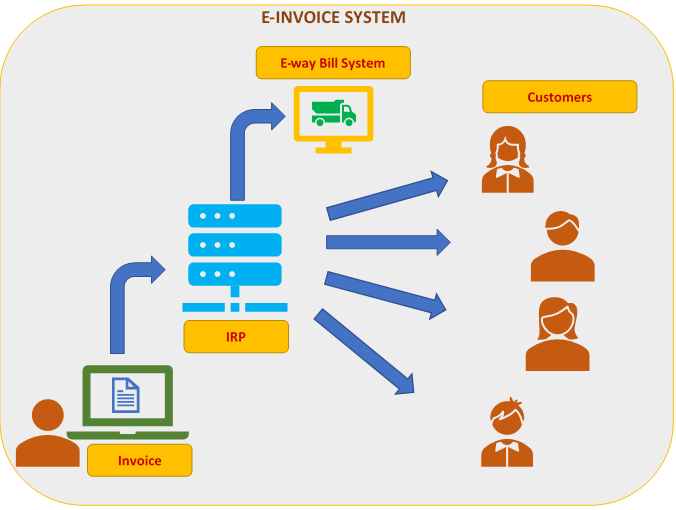
In simple terms, E-invoice means a standard set of fields which is uploaded on Invoice Registration Portal (IRP). The details which are available on a regular invoice will be uploaded to IRP. The process is very similar to data being uploaded for filing of GSTR 1.

However, there is a slight difference. In this system, a method has been introduced where an invoice is converted into a data with a common standard which can be read by anyone in the GST ecosystem.

The IRP will validate the data uploaded by the user and on successful validation, will generate a unique Invoice Registration Number (IRN) / Hash. The IRN will be generated by a hashing algorithm which will always remain unique for each invoice. Alternatively, the IRN can be generated by the accounting software/ERP using the hashing algorithm. The invoice will be digitally signed and a QR code for the same will be generated with the following parameters:

  • GSTIN of the supplier
  • GSTIN of the Recipient
  • Invoice number as given by Supplier
  • Date of invoice
  • Invoice value
  • Number of line items
  • HSN code of the line item having highest taxable value
  • Unique IRN / Hash

This will enable the invoice to be read by any handheld or other device with the functionality of reading QR codes.

What is IRN?

IRN is generated by the E-invoice system using a hash generation algorithm. For every document submitted on the E-invoice System, a unique 64 character IRN shall be generated. This will be unique for each invoice.

How does it impact the common user of the accounting software / ERP?

It does not at all. The invoices generated by you will remain same. The procedure would be performed by the accounting software / ERP probably in the background where the software will upload the details of the invoice to the IRP in scheduled batches.

World-wide implementation of E-invoicing (2018)

E-invoicing for B2B transactions is mandatory in the following countries:

  • Belarus
  • Brazil
  • Chile
  • Costa Rico
  • Indonesia
  • Mongolia
  • Rwanda
  • Turkey
  • Ukraine
  • Uruguay

Though E-invoicing is not mandatory but is allowed in the following countries:

  • Albania
  • Angola
  • Australia
  • Austria
  • Belgium
  • Botswana
  • Bulgaria
  • China (mainland)
  • Croatia
  • Curacao
  • Cyprus
  • Czech Republic
  • Denmark
  • El Salvador
  • Estonia
  • Finland
  • France
  • Germany
  • Guam
  • Hong Kong
  • Iceland
  • Ireland
  • Isle of Man
  • Israel
  • Italy
  • Kazakhstan
  • Korea
  • Latvia
  • Lithuania
  • Luxembourg
  • Macedonia
  • Malta
  • Moldova
  • Namibia
  • Netherlands
  • New Zealand
  • Norway
  • Pakistan
  • Papua New Guinea
  • Philippines
  • Poland
  • Portugal
  • Romania
  • Russia
  • Senegal
  • Serbia
  • Singapore
  • Slovakia
  • Slovenia
  • South Africa
  • Spain
  • Sri Lanka
  • Sweden
  • Switzerland
  • Taiwan
  • Uganda
  • United Kingdom
  • Vietnam

This signifies that India has decided to take a leap and be in line with global methodologies. However, we must understand that not many countries have made E-invoicing compulsory.

An implication can be drawn from this that challenges are also being faced by more developed countries than ours. Another drawn implication would be that the countries do not feel the need to do so. Whatsoever the case may be, we cannot ignore the benefits and challenges in adopting e-invoicing.

Why should we adopt E-invoicing?

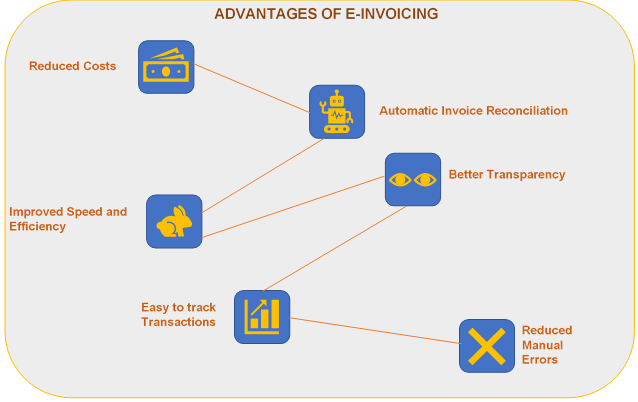
  • Since the outward supplies will be uploaded by the accounting software/ERP regularly and automatically, the time and effort of filing monthly / quarterly returns will be reduced considerably.
  • Since the suppliers upload their invoices regularly, the reconciliation process will be seamless or near-seamless. The data of the suppliers can be downloaded by the accounting software/ERP as and when they are uploaded and the entries pertaining to the inward supplies can be entered automatically on the basis of certain pre-defined set of rules.
  • One standard structure of the invoice will be followed throughout.
  • Regular reconciliation will reduce the possibilities of fake invoices.
  • E-invoicing will reduce printing of papers making it an eco-friendly measure.
  • Near real-time availability of information will ensure better accounting.
  • Automatic data will be transferred to the E-way bill system which will reduce time and effort.
  • Manual errors will be reduced if data is uploaded automatically by the system.

Along with the benefits provided to users, this will also strengthen the detective controls adopted by the GST departments where they will be able to detect fraudsters on the basis of irregular patterns.

Challenges in implementing E-invoicing

India is still developing and technology is yet to reach the masses. There are many businessmen in the MSME sector who are still generating invoices manually using invoice books. They provide the copy of the invoices to their tax consultants or tax return preparers for filing GST returns. Not everyone is equipped with the requisite infrastructure.

The E-invoice system cannot function to its full strength until and unless all the tax payers become part of the system.

Additionally, many accounting softwares/ERPs do not follow the standard system development life cycle (SDLC) and are prone to bugs. If the system improperly integrated and the exceptions are poorly handled, there exists likelihood of information not being completely uploaded to IRP. This will compromise the availability aspect and can prove a hurdle in successful implementation.

The invoices might not be synchronized during downtime of IRP, if any. Though, duplication of invoices have been controlled by the use of IRN/hash, there always remains the possibility of invoices being skipped for upload due to any error or incorrect behaviour of the accounting software/ERP or the IRP.

Also, with every structural update by the IRP team, the users will be required to update their accounting softwares/ERPs in order to be in sync with the E-invoice system. The users will have to ensure that they receive constant support from the accounting software/ERP provider.

Are we ready?

The GST council has implemented E-way bill in a phased manner. Speaking about readiness, we will never be completely ready considering the dynamics of India. Radical decisions will have to be implemented in a structured, systematic and phased manner.

During any implementation phase, resistance is always felt. It will be very important for the GST council to implement it in a manner that does not excessively impact the dynamics of business in the country but also does not excessively delay the implementation.

It is very important for the taxpayers to welcome the benefits of the system with open hands despite facing hurdles during the implementation phase. Keeping long term benefit in mind, the taxpayers should prepare, update and change with the system.

The law is definitely moving very fast. It’s time for the people to keep up with the pace and move along.

However, I would also like to emphasize that along with the tax payers, the authorities should also be provided apt infrastructure in order to retrieve the necessary data on demand. This will ensure minimum interactions between the authorities and tax payers and will not create further hurdles in the process.

The Ideal World Scenario

Let us assume a scenario where everyone has adopted E-invoicing and it is being used on near real-time basis. This scenario will enable:

  • Near real-time automatic verification of accounts between suppliers and customers.
  • Issuing fake invoices will be reduced considerably.
  • The origin of the accounts can be tracked along with the chain of invoices.
  • The business can set pre-conditions where automatic entry of inward supply transactions can be triggered on meeting of certain conditions.
  • The cost and efforts of compliance will be significantly reduced.
  • The speed and efficiency will be increased significantly along with significant decrease in manual human errors.

Have suggestions or feedback? Let’s connect to discuss more!

You may not require to avail GST registration if your turnover does not exceed ₹40 lacs

NOTIFICATION NO. 10/2019 – CENTRAL TAX dated March 07, 2019

This notification prescribes the category of persons who are exempted from obtaining registration under the Act w. e. f. April 01, 2019.

Applicability:

Any person who is:

  • Engaged in exclusive supply of goods

and

  • Whose aggregate turnover in the financial year does not exceed ₹40 lacs.

Exceptions:

  • The persons who are required to compulsorily register u/s 24 of the Act.
  • The persons who are engaged in making supplies of the goods under the tariff
    • 2105 00 00: Ice cream and other edible ice, whether or not containing cocoa.
    • 2106 90 20: Pan Masala
    • 24: All goods i.e. Tobacco and manufactured tobacco substitutes
  • The persons engaged in making intrastate supplies in the states of
    • Arunachal Pradesh
    • Manipur
    • Meghalaya
    • Mizoram
    • Nagaland
    • Puducherry
    • Sikkim
    • Telangana
    • Tripura
    • Uttarakhand
  • The persons who exercise the option of voluntary registration u/s 25(3) of the Act.

It is crucial to note that this notification applies to person who are in exclusive supply of goods and does not involve in any supply of service of any magnitude.

In a nutshell, a person making intra-state supply of goods exclusively and is not required to register compulsorily or not engaged in making supplies of specified goods or not engaged in making supplies in specified states are exempted from obtaining registration under the Act if the aggregate turnover in a financial year does not exceed ₹40 lacs.